‘And summer’s lease hath all too short a date.’
So Shakespeare tells us in Sonnet 18. And he’s correct. As we rattle on to the end of August, September is peeking cheekily round the corner and our parched and dry summer is coming to an end for this year. Tidying up in my garden, there’s already a sense of autumn, blackberries hanging off branches, leaves turning golden and falling from trees earlier than usual (though this is almost certainly due to the lack of rain) and the faintest sense and scent of smokiness in the evening air. It’ll soon be time to start digging out the jumpers to wear on crisp early morning mudlarking trips.
I’ve been holidaying in Roman Provence this July. Ok, I know other people’s holiday snaps and anecdotes are tedious but please bear with. My jaunt to the south of France has a purpose and is a glorious link to a recent mudlarking find on the Thames Foreshore. All will be revealed as you read on.
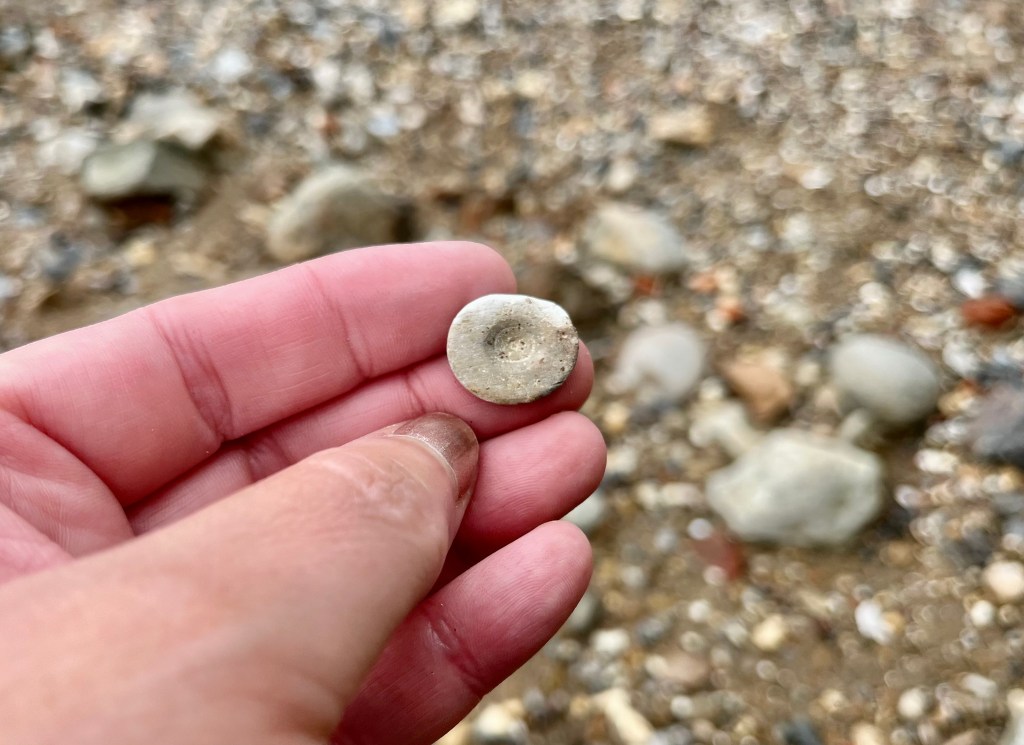
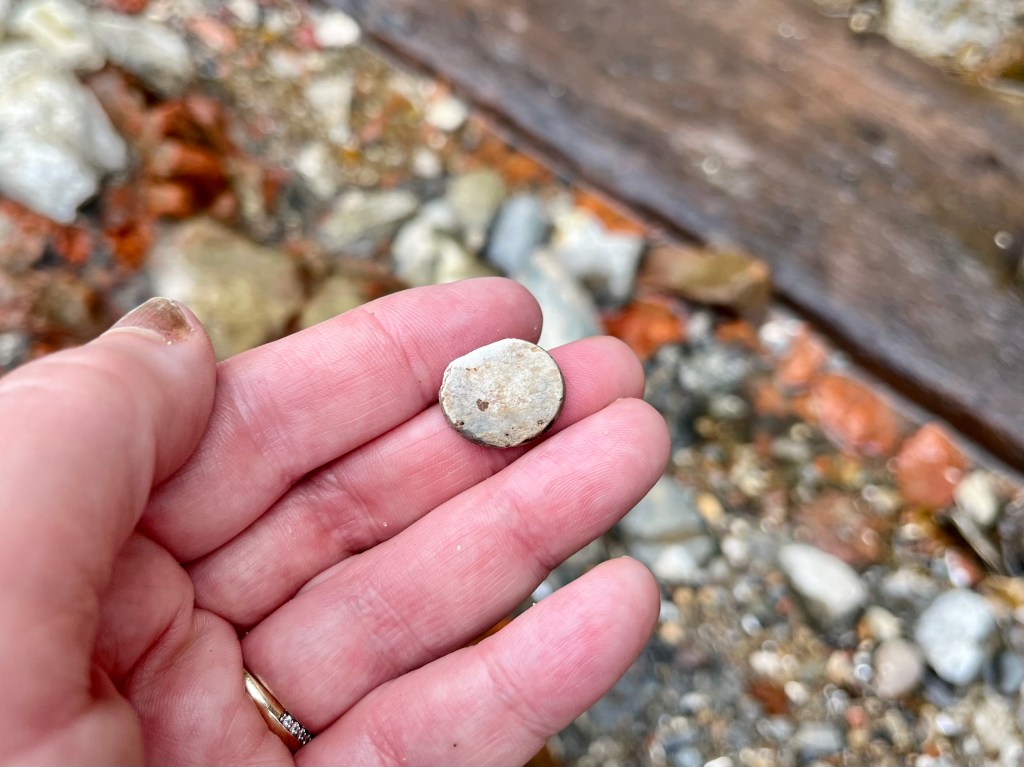
I’ve spotted Roman finds at various Thames Foreshore locations, not just in one particular area that’s known for its Roman artefacts. Without a shadow of a doubt far fewer finds are made here these days, as in most areas on the river, and yet there are always interesting discoveries waiting to be made.
A few months ago I found something white and round lodged between two rocks and an ancient piece of timber. Thinking it was a piece of shell I nearly didn’t pick it up, but of course I picked it up. Rule number one in the Mudlarking Rule book – always ALWAYS pick things up; turn them over in your hand, weigh them, feel them, look at them properly. If still in doubt, ask a fellow mudlark. It so happened that conveniently one of these was larking on the foreshore nearby and he confirmed it as a bone gaming counter, though an unusual one. (The fellow mudlark was called Guy – do give him a follow on Instagram @mudlarking.about ) I took the artefact to show my FLO (Finds Liaison Officer) Stuart Wyatt at the London Museum as per the requirement of every mudlarking permit holder, i.e. to report your finds regularly so that the most noteworthy can be recorded on the PAS (Portable Antiquities Scheme) database. The link is here for those who want to read more about this useful resource and fantastic archaeological database https://finds.org.uk/
And I’m thrilled to say my bone counter is now recorded on the PAS – Record ID: LON-AA4BF5 – if you wish to see the detail for yourselves.
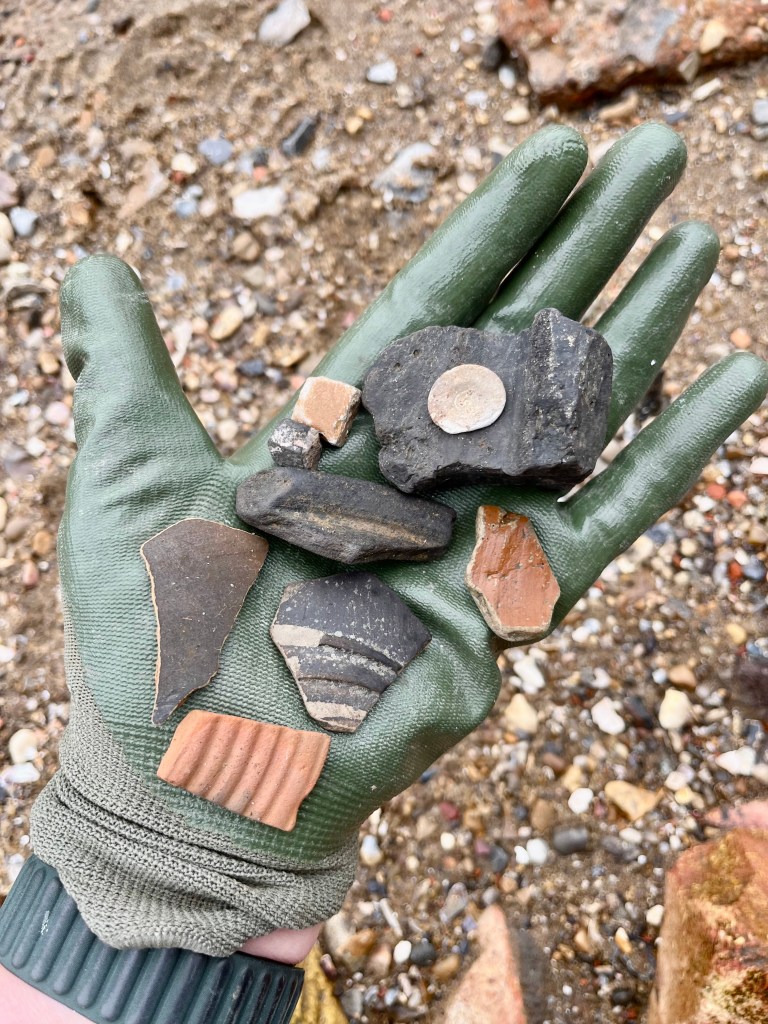
It’s incomplete, not as glamorous as some of the bone gaming counters found by other mudlarks on the foreshore, but as it’s the first one I’ve ever found of this type I’m more than happy with that. Dating from 50 – 410 CE, the counter itself is sub circular in plan and is undecorated except for a central concave depression and a small central hole on one side, possibly from a lathe. The edges are bevelled outwards. Similar counters can be found in the reference books and papers of Crummy (Nina Crummy, Roman small finds expert and also expert in Roman material culture.) Also known as a Kenyon type A, these were produced throughout the Roman period with little variation.
The gaming counter has been heated in a fire and turned white and distorted. Fellow mudlark and artist Ed Bucknall ( also well worth a follow on Instagram at @edjbucknall) has suggested this could indicate the gaming counter might have been part of a Roman cremation. In other words, funerary goods.
The Roman Empire was multi-cultural and allowed a surprisingly diverse number of religious beliefs, though some were initially treated with suspicion, hostility and subject to persecution, e.g Christianity. Emperor Constantine famously converted to Christianity before the Battle of Milvian Bridge in 312 CE, though he continued to patronise other religions, clearly hedging his bets in order to safeguard his soul in the afterlife ‘just in case.’ Emperor Theodosius was the one who finally made Christianity the official religion of the Roman Empire in 380 CE.
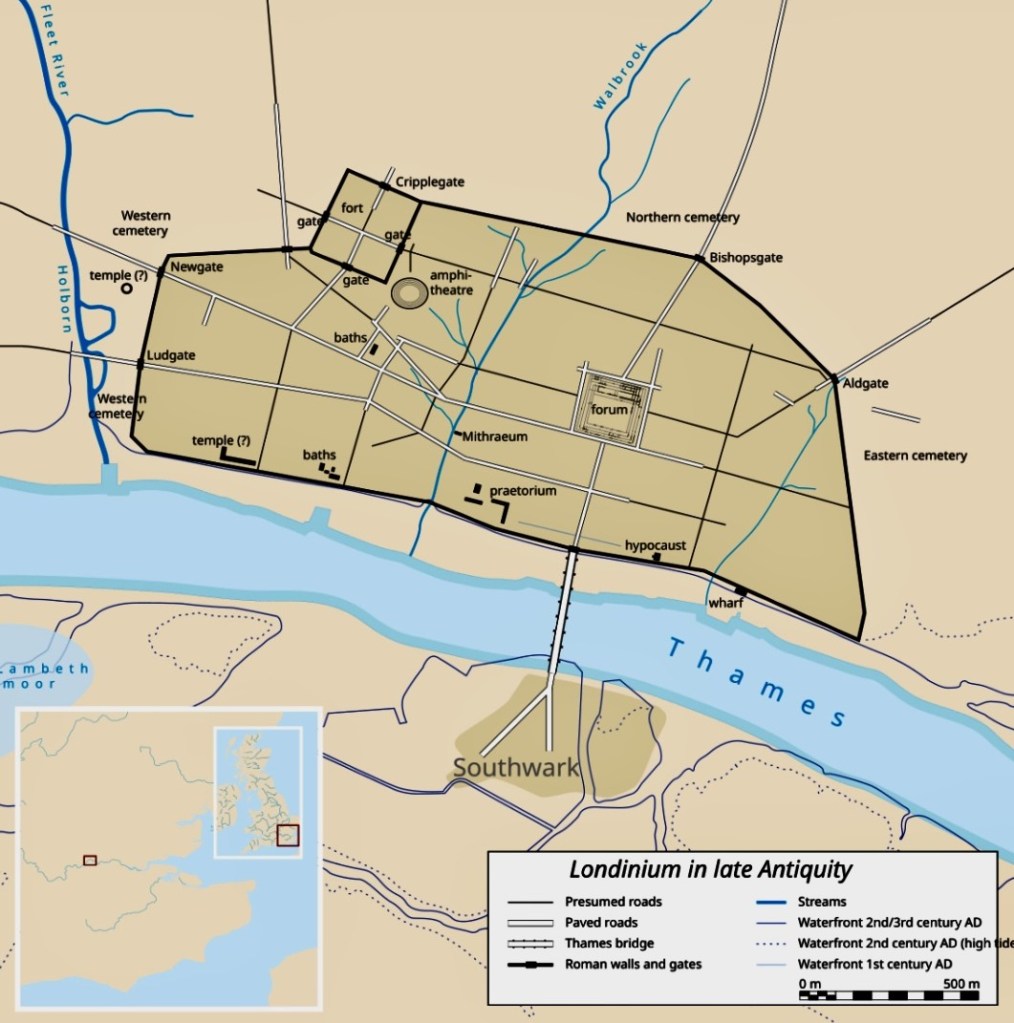
In Londinium as elsewhere, burial customs were adopted from all parts of the Roman Empire, adapted to suit, then later abandoned. Wealthy Roman citizens were able to commission elaborate tombs in contrast with those who were poor and whose bodies were often dumped into open pits. Burials were not permitted within the city walls and cemeteries were located away from cities, for both public health, superstitious and religious reasons, tombstones often found along main roads. Archaeological excavations of burial grounds give us a great deal of information and show a wide range of burial rites. These include conventional inhumation through to cremation and ‘bustum’, where the body was cremated over a burial pit. Many types of grave goods, including food offerings and personal objects, have been found alongside these burials. What is now the Southwark area of modern London has been the site of excavation for decades and archaeology has revealed it to have been an important place for the burial of Londinium’s dead. It was a significant area, though outside the main city walls, accessible by the first ever London Bridge built by the Romans across the River Thames.
London and the Thames looked very different two thousand years ago. The south of the river was marshy, what we now know as Southwark was essentially two large gravel islands which formed the southern bridgehead for the original (Roman) London Bridge. Major roads were built here to connect to other Roman cities in the south of England e.g. Watling Street (connecting Londinium to Canterbury) and Stane Street (connecting Londinium to Chichester.) Museum of London Archaeology (MOLA) have carried out excavations in Southwark and archaeologists have found remains of high status stone buildings together with mosaics, hypocaust heating systems and painted wall frescos.
Wooden jetties, warehouses and other remnants of waterfront activities show that the Southwark side of the river was just as much a centre of trade as the north side, and with strong links to the rest of the Roman Empire.
I was fascinated to read via the Southwark Council website that south of Borough tube station the Roman landscape was once dominated by a very large cemetery, including a number of mausoleums, walled areas containing graves and monuments to the dead lining the road along Stane Street and Watling Street. The link to more information about the history of Southwark is here:
I don’t know if my bone gaming counter came from a cremation in Southwark, but it came from somewhere and it might as well have been from Roman Southwark as anywhere else. Though there were also other cemeteries north, east and west of Londinium’s city walls.
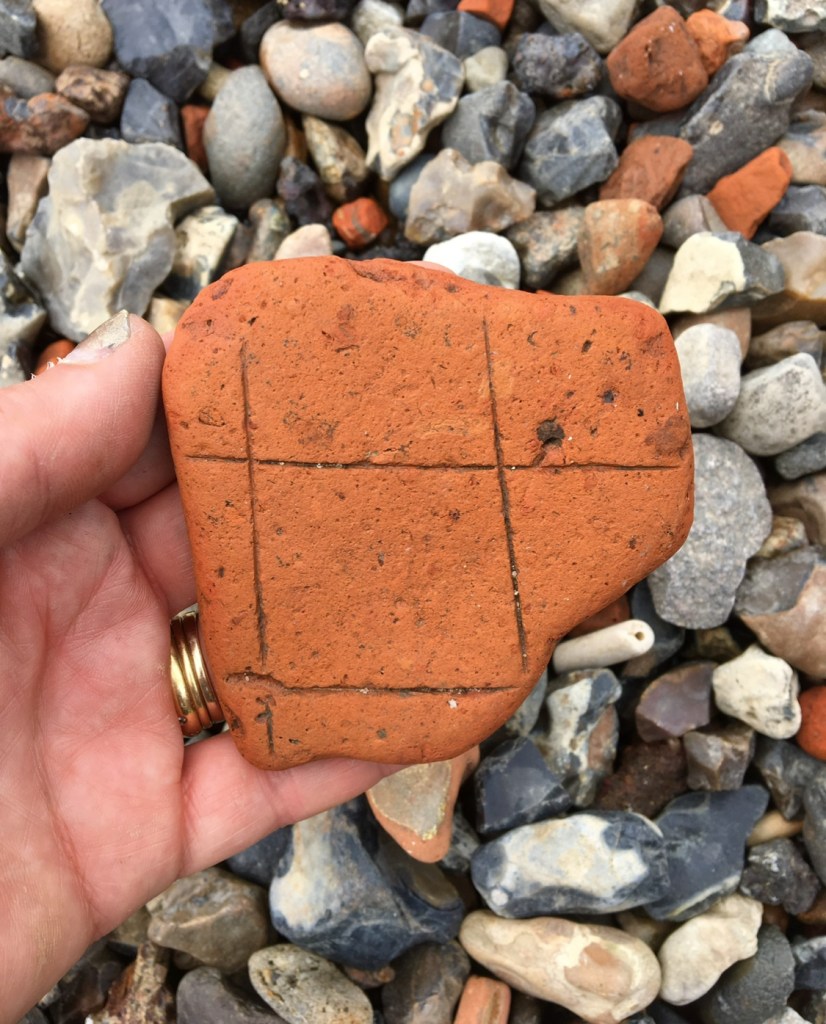
The river often plays games with us and coincidentally I found a worn, incomplete section of terracotta roof tile near where I’d found the bone gaming counter. I like to imagine someone beavering away making tiles and laying them out to dry in a courtyard. Boredom sets in and they idly mark a square piece of spare clay into a grid. Not a fancy gaming board that a high status individual or soldier might have used for the playing of Ludus Latrunculorum (similar to chess or draughts, the winner is the player who’s captured the most pieces) but a poor man’s or woman’s gaming board – functional, portable, will do the job. Something to while away the long hours in the tile maker’s yard when the boss wasn’t looking. That said, it’s impossible to tell if this is Roman clay; it could be later, but was found in an area of foreshore where Roman artefacts are found, and it’s the rich terracotta colour of the Roman era. I’ll never know, but it’s fun to let the imagination run riot and there’s no harm in speculating. And on this note, a third favourite mudlarking Insta recommendation is Peter (aka @ _tidetravel ) who writes in a much more evocative way about his mudlarked finds than I’ve done above, and really takes you back in time with his stories and descriptions of artefacts. He’s well worth a follow.
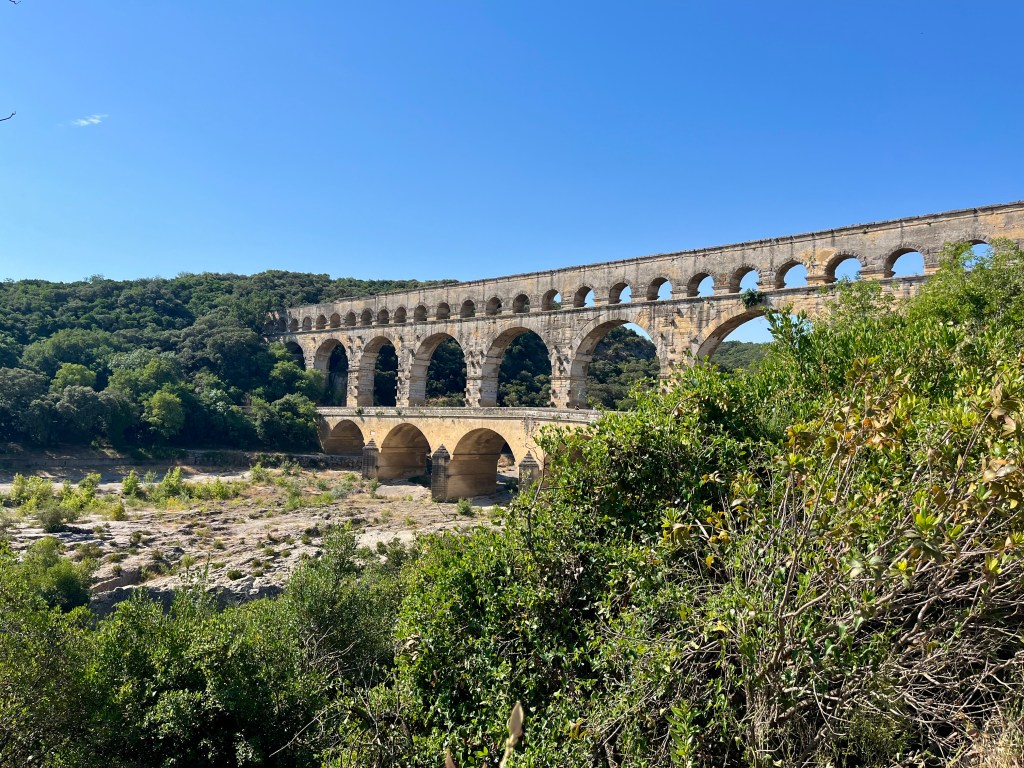

I am obsessed with Provence in the south of France. Mostly because of the history – Provence has some of the world’s most impressive Roman remains – but also the food and wine are rather good too. The name ‘Provence’ itself is a translation of the word ‘province’, i.e province of Rome. In Arles, Aix-en-Provence, Nîmes, Orange and Vaison-la-Romaine, you will find some of the best preserved arenas, amphitheatres, spas, villas and other monuments anywhere in the Roman world.
I’ve wanted to visit the Pont du Gard for my entire adult life and finally managed to do so this summer. It wasn’t hugely busy either, though we went on a scorchingly hot July day. Situated in the Gard department of Languedoc-Roussillon, 20 kilometres from Nîmes (Roman Nemausus), the Pont du Gard was an aqueduct constructed by the Romans in approximately 19BCE to 50CE as part of a system to carry water for 50 kilometres across hills and valleys to the wealthy of Nemausus for their fountains, baths, gardens and drinking water.
After the Roman Empire collapsed, the aqueduct fell into disuse. Over time the stone blocks were looted, eventually it was used as a toll bridge, then repaired and restored to the stunning monument we see today. There is also a museum, cafés and a gift shop as you enter the site (and some of the best ice cream for sale in Languedoc-Roussillon.)
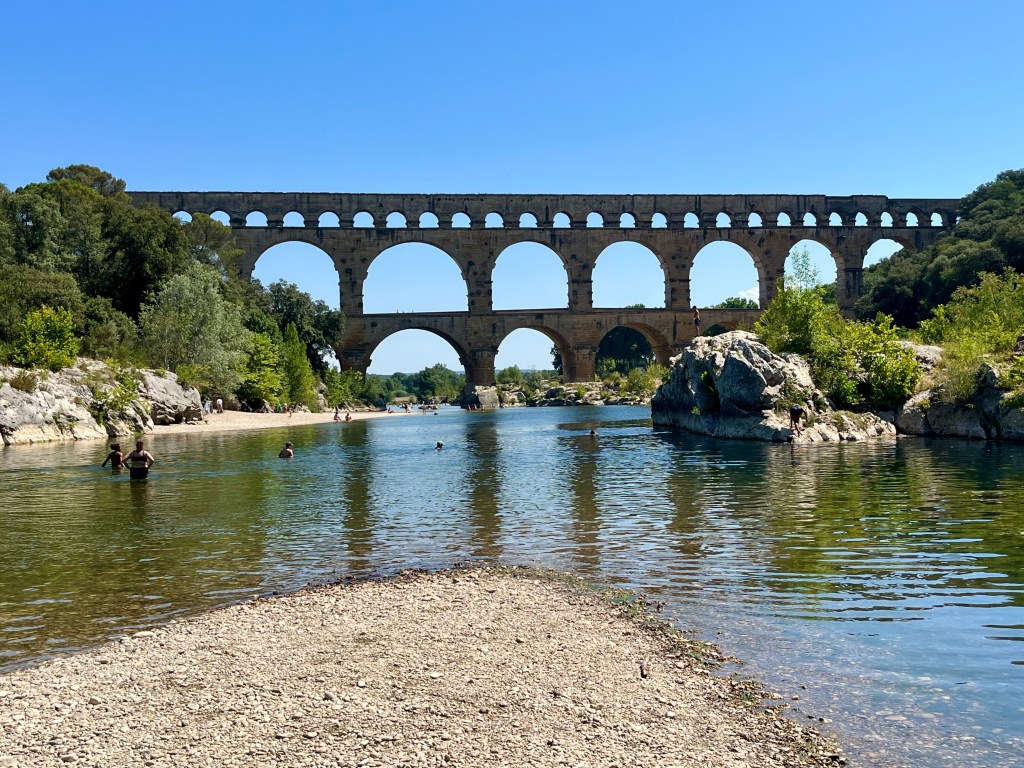
Flowing through the arches of the aqueduct is the gentle river Gardon that can rise and flood and be torrential during the winter months. We swam in its waters on the hottest of hot days of our visit and it was difficult to imagine it as a viciously turbulent mass of water. Roman engineers were highly skilled and designed the foundations of the bridge in a shape like the tip of the prow of a ship, thus helping protect the aqueduct from violent currents. As we swam, and I checked the shallow river bed for artefacts (there weren’t any but it’s impossible to keep that mudlarking eye still, even when on holiday) I imagined the labourers and soldiers building the aqueduct all those millennia ago and wondering if they also played board games in their precious downtime using bone gaming counters, just like the one I found on the Thames. I’m sure they did.
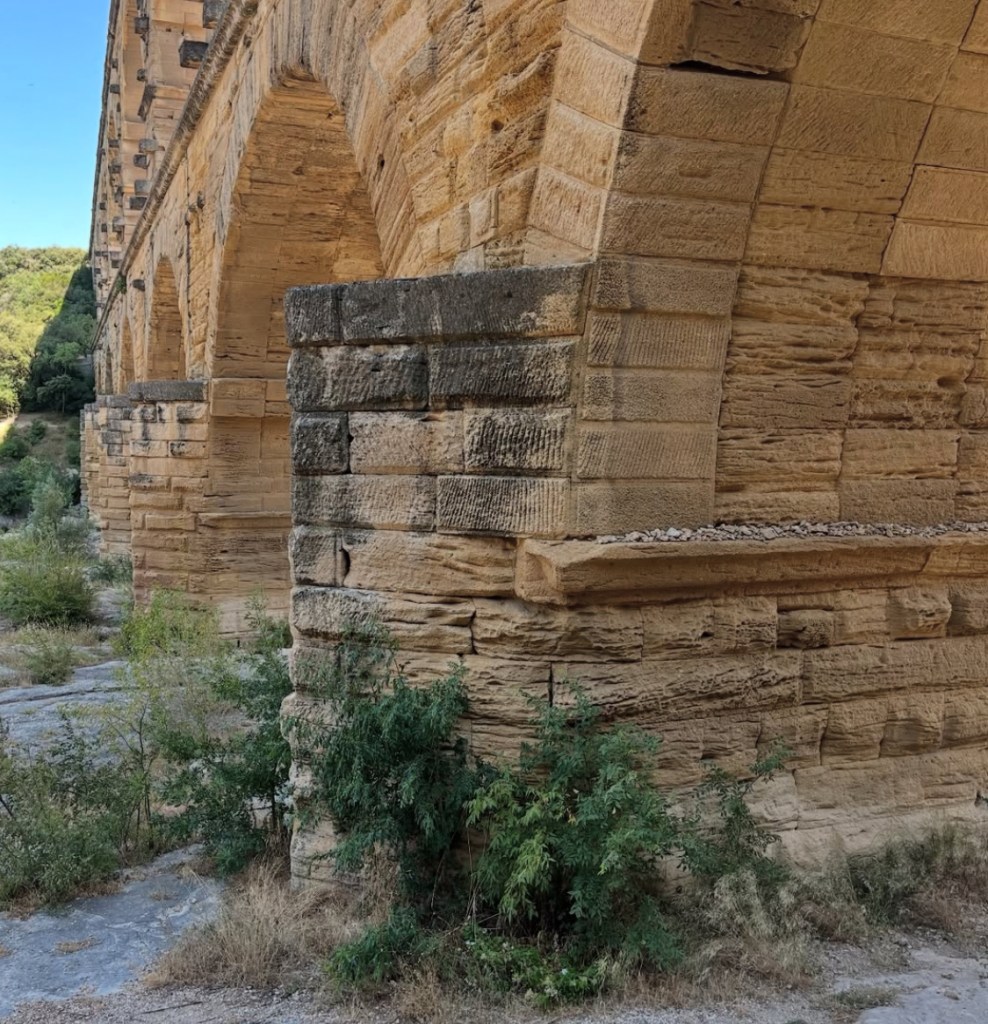


Prior to making our way down south to Provence we stopped off in Paris for a few days to visit my two favourite museums in the capital. If you haven’t been, I highly recommend the Musée Carnavalet ( free to enter) in Le Marais and the Musée Cluny (not free to enter) in St Germain-des-Prés; both museums are closed on a Monday. If you can’t cope with the huge crowds in the Louvre or Musée d’Orsay then these two smaller museums are perfect for you. The Cluny is France’s National Museum of the Middle Ages. In the heart of the Latin Quarter, it’s an amazing collection of historical buildings comprising Gallo-Roman thermae or public baths with divine exhibits everywhere you look, many familiar to my fellow mudlarks. Gazing at the contents of the cabinets it really was like greeting old friends.
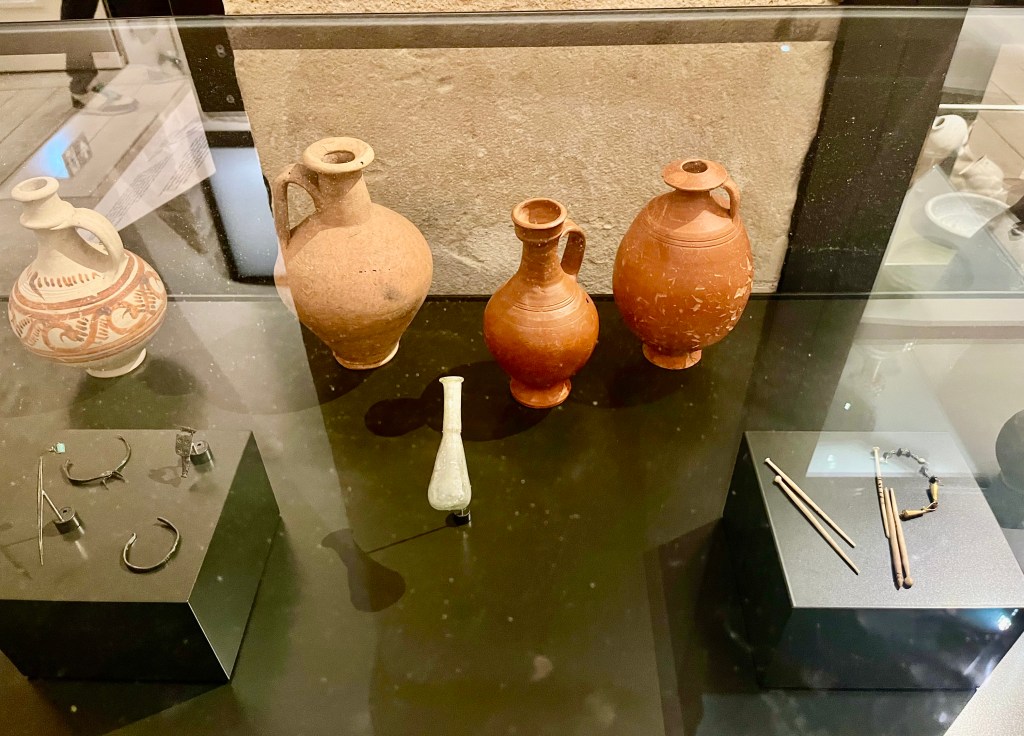

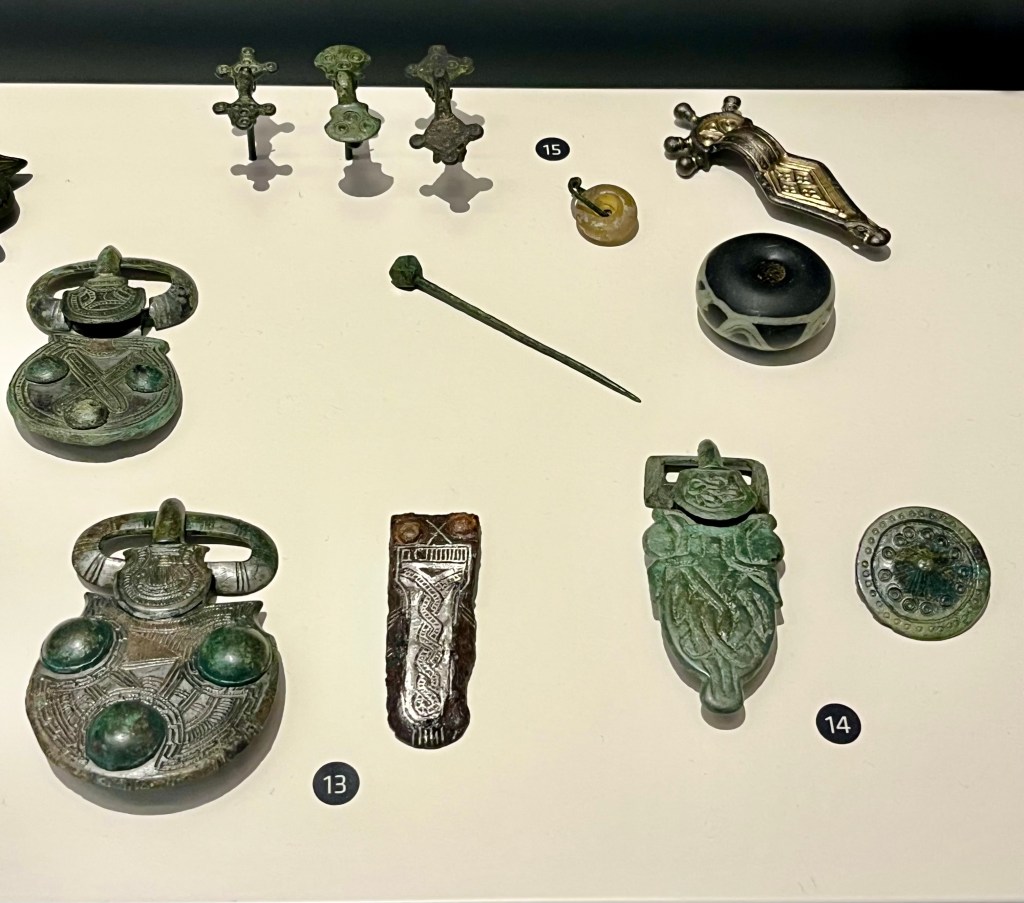
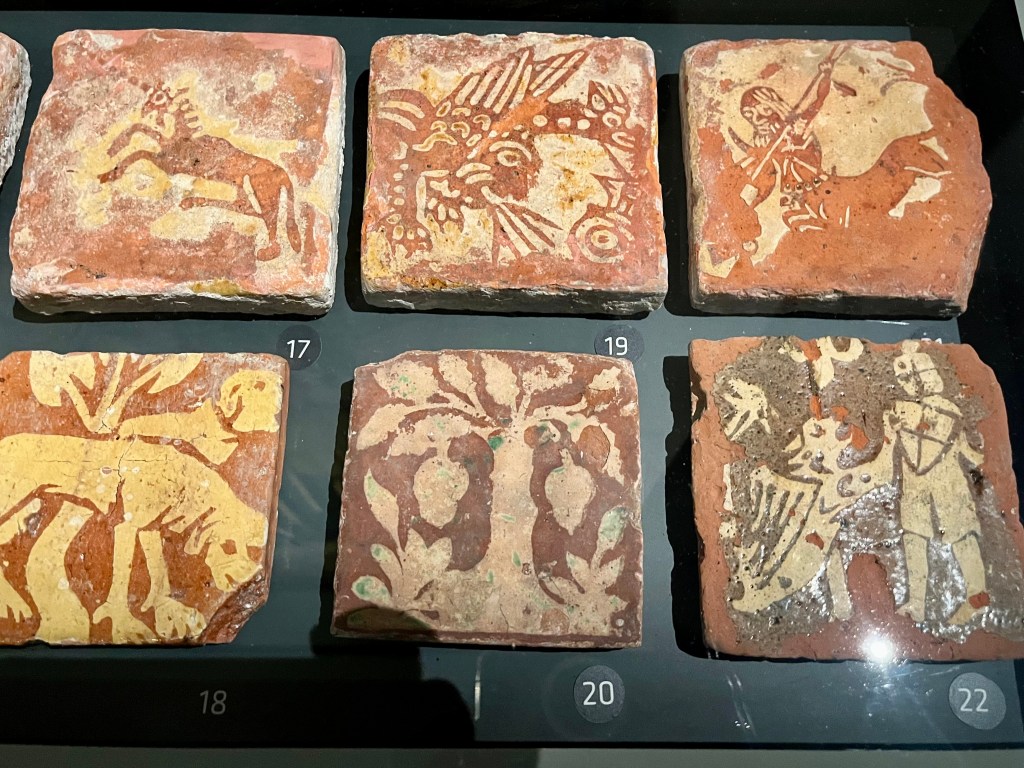
Strolling from the Carnavalet to the Cluny, where many familiar saintly friends were on display, it was comforting to see this sort of Medieval ‘Entente Cordiale’ via the medium of religious artefacts bought, and lost, by pilgrims over the centuries. Featuring St Thomas Becket, St Veronica, St Anthony, Our Lady and also many unfamiliar ones. Clearly pilgrims travelled to many different shrines across Europe and quite a few of the badges on display have not, to my knowledge, been found in the Thames e.g. St Fiacre en Brie, St Maur, St Vincent, St Léonard, St Julien of Le Mans, St Geneviève and St Corneille.


And I’m finishing this blog with a ‘save the date’ reminder. The first of our mudlarking exhibitions for Totally Thames 2025 will be taking place at the Guildhall Art Gallery in the City of London, on Saturday 6th September and Sunday 7th September (I’ll be exhibiting my finds on the 6th only.) If you’ve never visited, the Guildhall is the site of Londinium’s amphitheatre and a stunning building, the perfect setting for a mudlarking exhibition.
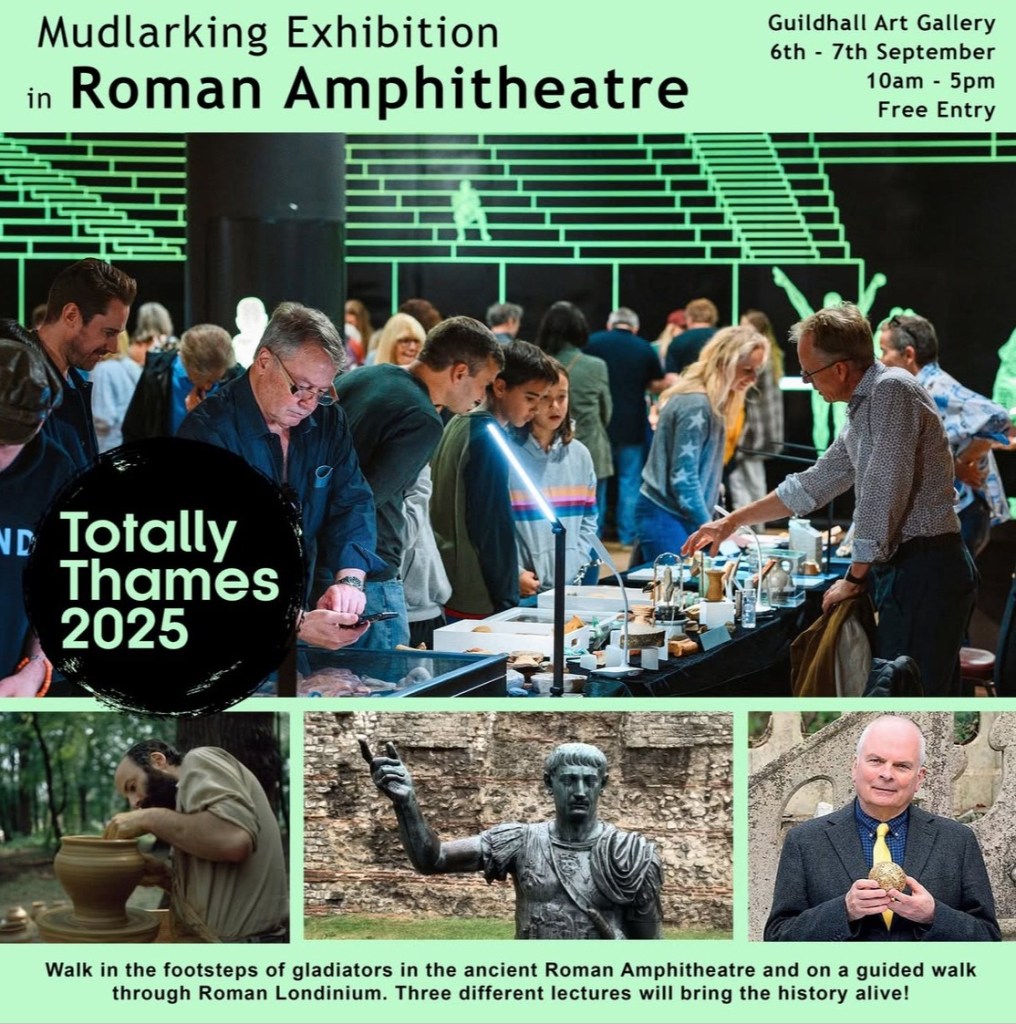

The link below will take you to the complete calendar of events for Totally Thames 2025, including the fascinating ‘Lost and Found’ series of events. These feature the stories of prison hulks, ancient wharves, East African seamen who settled on the Thames and many others revealed from archives, family histories and mudlarked objects from the river. For centuries the Thames has re-shaped the city of London and its people, connecting local communities with global flows of trade, migration and ideas.
Do come! Looking forward to seeing everyone there.
NB It is a legal requirement to have a valid permit from the PLA (Port of London Authority) to mudlark on the River Thames.
 A Mudlark's Diary