I haven’t been able to mudlark for the last couple of months – a combination of family wedding preparation and recovering from surgery has kept me away. So it was a real joy to return the the Thames Foreshore this week and get stuck in the mud again (though not literally…. thank goodness.) The sun shone and the weather’s been perfect, particularly in the early mornings, though getting hotter as the day kicks in.

I visited a few favourite river spots this week and, although I didn’t make that many finds (to be honest, you often don’t find that much on one visit, however fruitful some mudlarking accounts may look on Instagram) – I did come away with one or two nice things and was more than happy with that.
My star find on Monday morning’s trip to the foreshore was this fabulous clay pipe bowl. With partial stem (it’s not often one finds a complete, undamaged clay pipe these days though it does happen if you’re lucky) and bowl showing the crest of the Prince of Wales – ostrich feathers with the motto ‘Ich Dien’, or ‘I serve.’

It’s thought the crest was adopted after the Battle of Crécy in 1346 when the Black Prince (Edward, eldest son of Edward III) killed the King of Bohemia and assumed his crest design and motto.
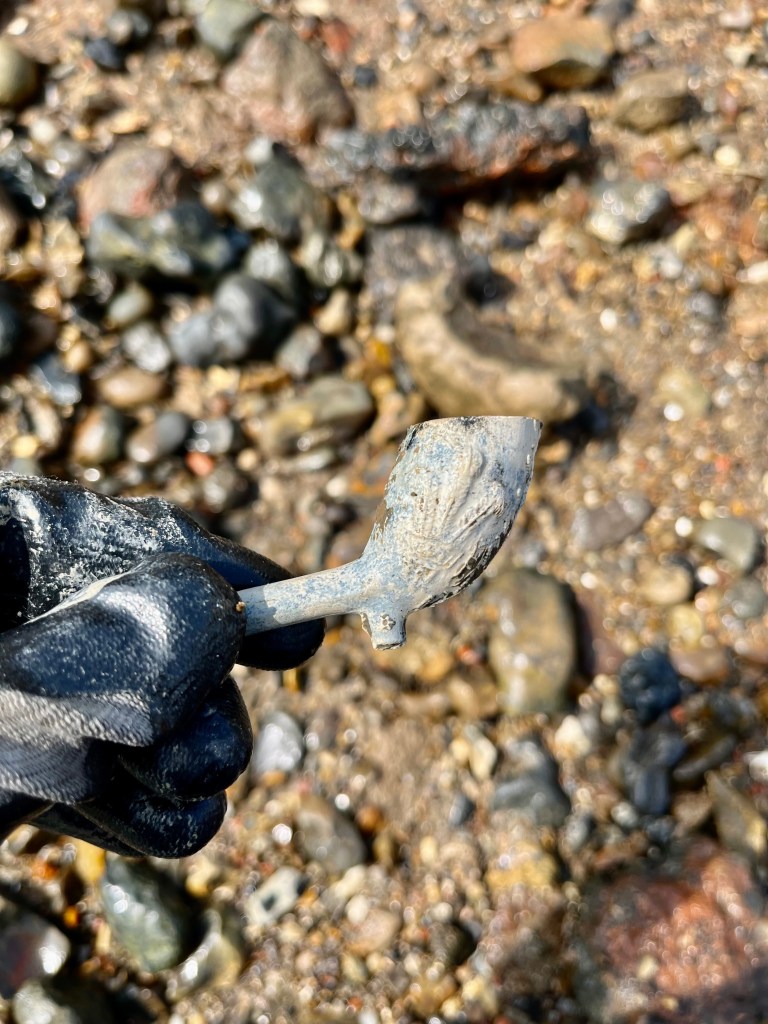
The actual title of Prince of Wales was thought to have originated when Edward I of England subjugated Wales in 1276. His eldest son, Edward II, born in Carnarvon in 1284, was created the very first Prince of Wales in 1301, the title being passed on to each subsequent eldest son. The title continues to this day, a gift of the monarch, the current incumbent being Prince William, eldest son of newly crowned King Charles III. Recent polls suggest that the average Welsh citizen, if not strongly opposed to being linked to this archaic and largely symbolic title is, at best, increasingly indifferent to it.
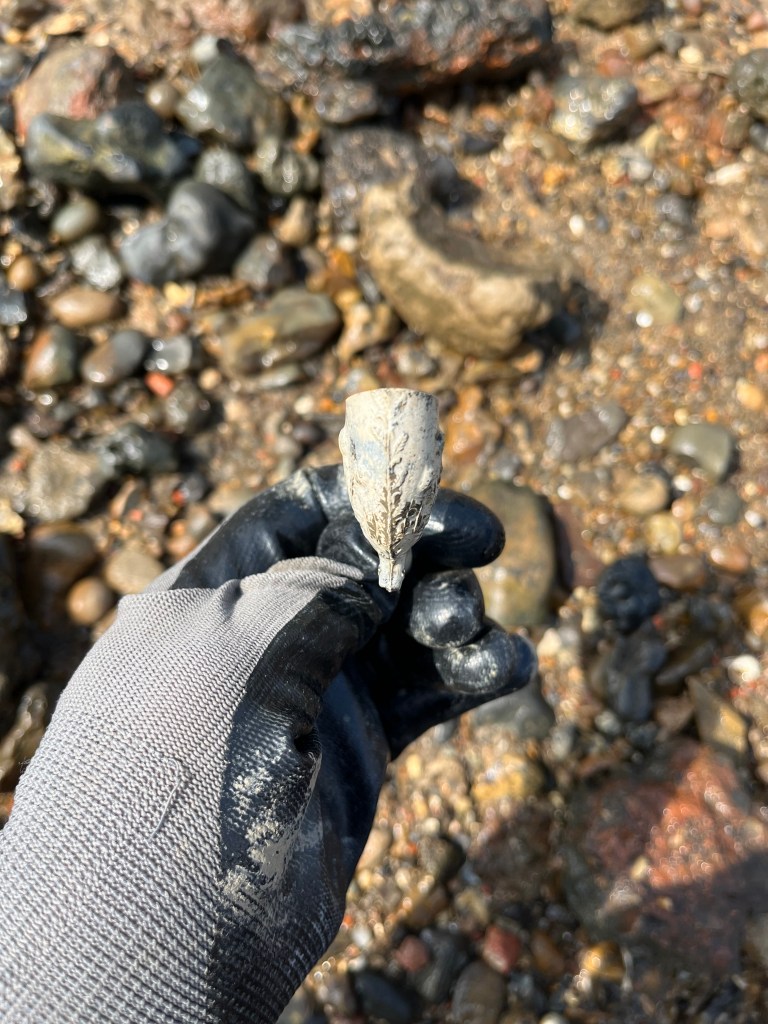
A large number of Prince of Wales armorial pipe bowls found in London date from the second half of the 18th century, though some later ones are from the 19th century. The second half of the 18th century was, however, the period when the most elaborate of these pipes were produced in many different designs, each variation indicating who the pipe maker was.
The pipes were made predominantly to display loyalty to whoever was the Prince of Wales at the time but the ostrich feather motif was also linked to a large number of taverns. Bryant Lillywhite in his book ‘London Signs’ records over fifty ‘Prince of Wales’ taverns between 1606 -1851, as well as at least eighty five called ‘The Feathers.’ This design would therefore have featured on numerous tavern pipes.
And although commonly used as a tavern sign, the ostrich feather motif was also used by a variety of tradesemen, particularly booksellers, and sometimes appear in 17th – 19th century tokens.
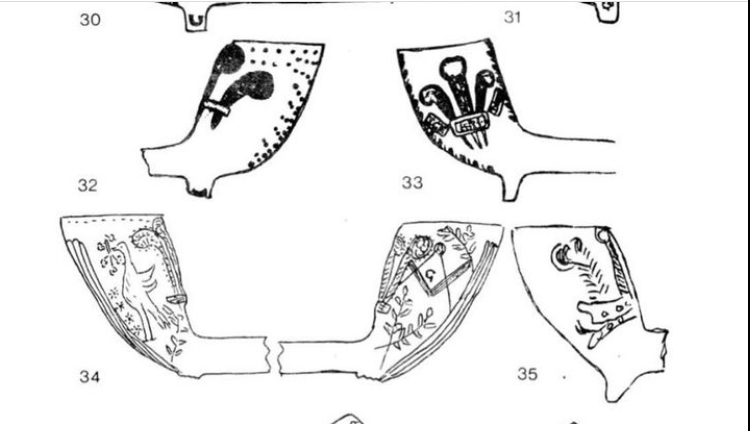
My own clay pipe find is similar to the illustration in Fig 33, and other examples of this style of armorial Prince of Wales design on a pipe bowl have been found at Battersea, Chiswick and Lambeth, where we know pipe makers were in business making these clay pipes.
Researching this clay pipe design I fell down a rabbit hole of alternative pipe research new to me, and which led me into some fascinating yet dark areas of history. Who knew clay pipes were once such rigid indicators of social class and even criminality?
I am particularly grateful to Sarah Inskip and Angela Joy Muir for research they’ve done into past criminal records showing how clay pipes, particularly the stem, were both frequently used as a lethal weapon and also as a barometer of morality, especially where women were concerned.
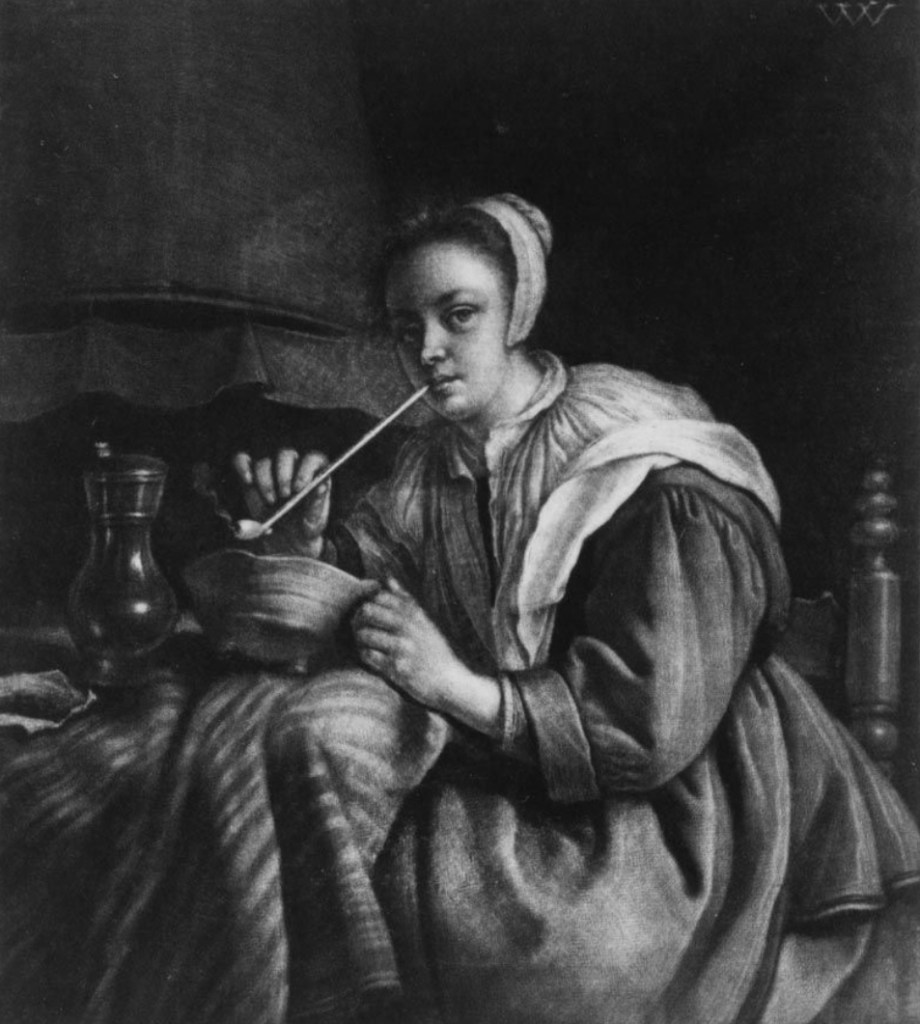
By the 18th century, public smoking and tobacco use were considered a distinctly unfeminine habit, restricted mostly, though not entirely, to women from the labouring classes. Depictions of female pipe smoking were frequently associated with rough manners, loose morals and sex work.
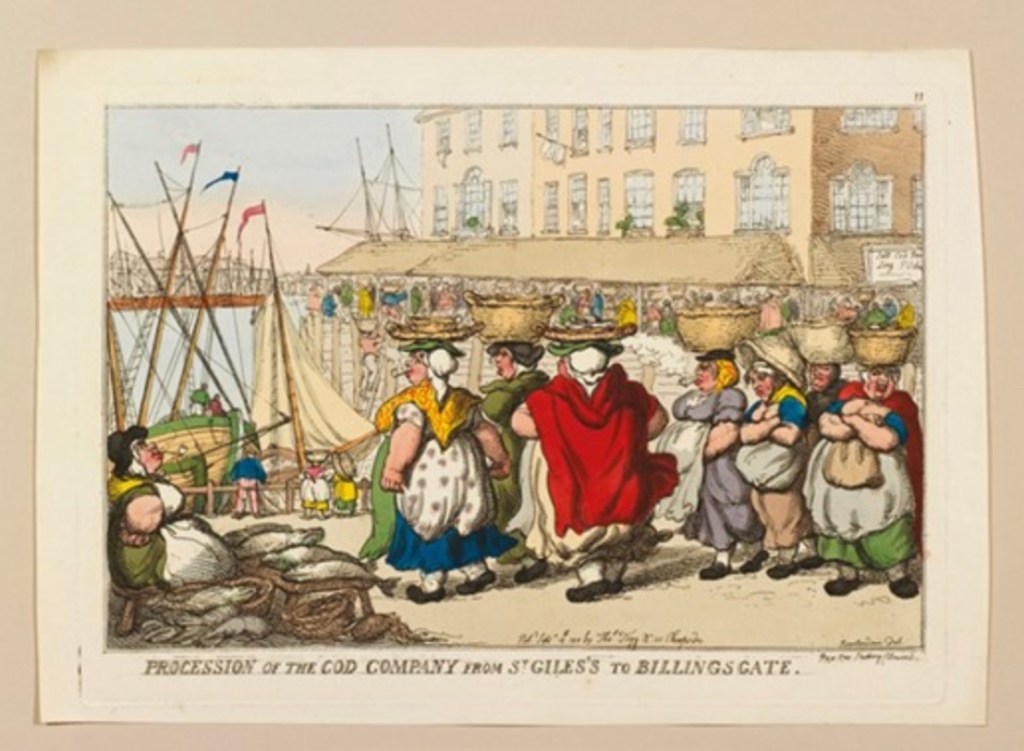
Thomas Rowlandson’s satirical print (see image above) depicts several Billingsgate fishwives carrying baskets on their heads while smoking clay pipes. The term ‘fishwife’ of itself has lingering (and, to my mind, unfair) connotations of coarse, filthy, gossiping, screeching women, whereas the reality was that the lives of these women were hard and unforgiving as they heaved and carried and sold fish in order to eke out a living. Higher status women in Rowlandson’s other prints were, of course, never featured with clay pipes. In one of his other prints – ‘St Giles Courtship’ – a pipe-smoking soldier is shown flirting with a young working class woman whose breasts are exposed and who is wearing a hat with a clay pipe tucked into the band. The message was clear though hypocritical to our modern eyes – ie that clay pipe smoking was not a ladylike thing to be seen doing.
Bewteen 1615-1904, sixty six different instances were found in court records showing clay pipes being involved in threats to life. Many of the cases are from London (thanks to the availability of Old Bailey records, an invaluable source of historical criminal information) and the frequency with which London cases were reported nationally, though documents and newspaper reports show that similar cases were widespread throughout Britain.
These cases involved the use of a clay pipe as a weapon of assault, some of which resulted in death, as well as assaults, wounding or cutting of the victim including eye gouging.
There were many scenarios where a violent attack involving a clay pipe -turned-weapon escalated from what had started as a minor dispute. Records show that in 1882 David Bratley was stabbed in the face with a clay pipe stem by Edward Seamey at a coffee stall, while Daniel Mynch was charged with stabbing James Barry in the eye in the street after he refused to give him some tobacco in 1878.
Many other court cases involve clay pipe attacks where people were socialising together and had drunk too much, also attacks where people were in close proximity eg in prison, or within a strained domestic setting, eg family, where records show a husband violently assaulting his wife, lodger or even landlord.
Old Bailey records show that clay pipe assailants were predominantly men (of sixty three cases where the gender of the perpetrator was known, fifty nine involved a male assailant) though women feature as aggressors too, although they were more likely to use a clay pipe as a weapon for reasons of self-defence or to attack another woman.
In 1858 at the Cherry Tree public house in East London, Margaret Shea was charged with using a pipe to ‘unlawfully wound and cut the face’ of Ellen McCue, a costermonger ( a fruit and vegetable seller) after a dispute broke out in the street between the two women’s sisters. In Cardiff in 1864, Ann Cummings ‘a gaudily attired female’ was charged with stabbing a sailor by the name of James Slack in the face with a pipe stem, puncturing his cheek and narrowly missing his eye. In Ann’s defence she stated that James and another man approached her and another woman and ‘attempted unwelcome familiarities’ with them. Although not explicitly stated, there are conflicting acounts of what happened and the suggestion is that Ann may have been a sex worker soliciting on the street, her case and that of other women showing details of the lives of sex workers in 19th century Britain and the risk of ever present violence that shadowed them. In these instances, the clay pipe became a weapon in women’s hands just as it did in men’s.
It was good to be back on the Thames Foreshore again and I’ll be treating my clay pipe finds with a new found caution.
Sources:
‘The Archaeology Of The Clay Tobacco Pipe’ edited by Peter Davey
Bryant Lillywhite ‘London Signs’ (pub 1972)
‘Clay Pipes bearing the Prince of Wales Feathers’ by Richard Le Cheminant
‘Material encounters: the alternative use of clay tobacco pipes in England and Wales, c.1600 -1900’ by Sarah Inskip and Angela Joy Muir
 A Mudlark's Diary
Glad to see you are back in the foreshore and thanks for this fascinating article outlining the alternative uses of a clay pipe!
LikeLike
Thank you so much, Anne. Who knew a clay pipe stem could be so dangerous?
LikeLike
I know it’s scary!
LikeLike
Thank you for a fascinating and educating read. Love the well chosen images too .
LikeLike
Thank you, Caroline!
LikeLike
And so pleased you’re back on the foreshore again too! ❤️
LikeLike
The foreshore is the best medicine x
LikeLike
Mudlarking seems the perfect activity – out in the fresh air walking and looking for and finding interesting, historical items. I enjoy your Mudlark Diary very much and congratulations on finding the wonderful clay pipe.
LikeLike
Thank you, Gretchen. You’re very kind.
LikeLike
I just stumbled across this post – so glad you found our article useful! I really enjoyed reading this post, and have always wanted to try mudlarking.
LikeLiked by 1 person
Hello Angela. Thank you for your lovely comment and finding my clay pipes blog. Your and Sarah’s research and writing in ‘Material Encounters’ was so useful re bringing a new insight into women and alternative uses for clay tobacco pipes. It was wonderful to discover it and point my readers in your direction for those who wanted to read more and in greater detail. Thank you again.
LikeLike